
Quick Summary
Accumulated dust, humidity, and biological biofilm on HVAC evaporator and condenser coils restrict airflow, drive up electricity bills, and trigger system freeze-ups across Richmond residences. As a dedicated local specialist, Northstar Air Duct Cleaning Service San Francisco delivers professional HVAC coil cleaning in Richmond using commercial-grade, neutral-pH foaming solutions and calibrated low-pressure rinses that safely restore heat transfer without damaging delicate fins. Readers will understand the distinct maintenance requirements of complex coil configurations and can contact Northstar Air Duct Cleaning Service San Francisco for a free written estimate or same-day inspection to restore optimal climate control.
HVAC Coil Cleaning in Richmond – Restore Airflow Fast
If your heating or cooling system is pushing weak or lukewarm air through your vents, dirty coils are usually the primary culprit. Environmental dust, airborne debris, and humidity create buildup on both indoor evaporator coils and outdoor condensers. Over time, this air-side fouling chokes airflow, drives up utility bills, and risks freezing your entire system.
A study from Lund University on ventilation heat exchangers provides general evidence that air-side particulate buildup sharply reduces thermal efficiency while driving up pressure drop across the coil face. Clearing out that matter requires the right approach, as improper cleaning methods or standard hardware-store aerosol sprays can cause metal corrosion rather than fix the problem.[1]
What to Expect During a Professional Coil Cleaning
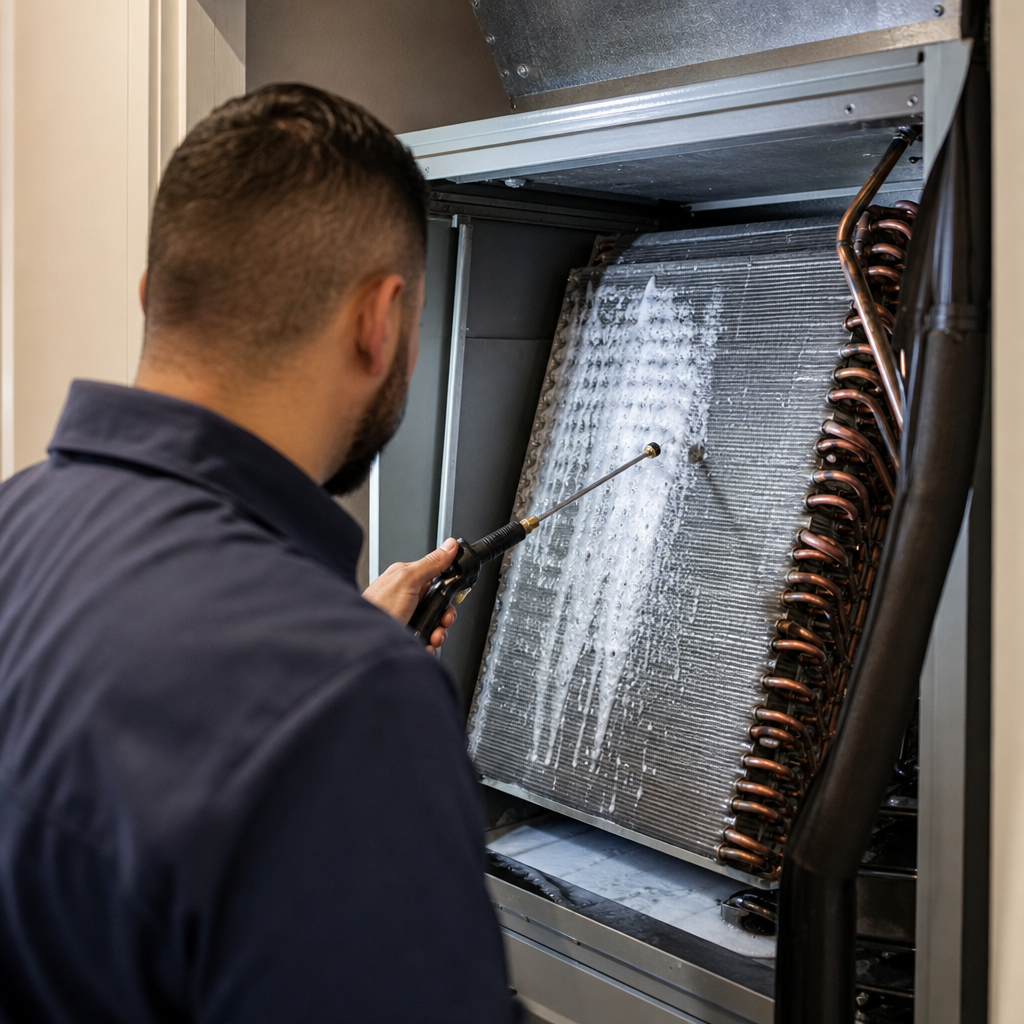
Professional HVAC coil cleaning targets the two main heat-exchange components in your split or packaged system: the indoor evaporator coil (often located in a tight closet, crawlspace, or attic plenum) and the outdoor condenser unit. The objective is to restore unobstructed heat transfer without bending soft aluminum fins or stripping protective metal coatings.[5]
Immediate Airflow and Efficiency Gains
When dust, pet dander, and moisture pack into the fin gaps, your blower motor fights high static pressure just to move air into your living spaces. Removing that packed layer drops static pressure back to normal levels, allowing air to circulate freely and cutting down runtime cycles on your compressor and furnace.
Safe Buildup and Biofilm Removal
Indoor evaporator coils operate in a damp dark environment, turning dust into a wet biofilm. As practiced by specialists like Northstar Air Duct Cleaning Service San Francisco, technicians use pH-neutral, non-acidic cleaners paired with controlled low-pressure water rinses or specialized self-rinsing foaming agents. This breaks surface tension and washes away biological slime and grime without etching the copper tubes or eating through the thin aluminum fins.
What Does HVAC Coil Cleaning Cost in Richmond?
Need hvac coil cleaning in Richmond?
We’re available now — call for a fast, free estimate.
Local pricing for HVAC coil cleaning varies based on system configuration, physical accessibility, and the level of buildup. Because individual installations differ significantly, a site-specific quote is needed to determine the exact cost. Outdoor units are typically straightforward to access, while indoor coils encased inside sheet-metal plenums demand more labor.[3]
Estimated Pricing Breakdown
| Feature | DIY Aerosol Sprays | Handyman Service | Professional HVAC Specialist |
|---|---|---|---|
| Debris & Buildup Removal | Surface level only | Moderate surface wash | Deep extraction through the fin pack |
| Fin & Metal Protection | High risk of chemical corrosion | Basic high-pressure wash (risk of fin bending) | Calibrated low-pressure rinse, neutral pH agents |
| Drain Line & Pan Service | Not included | Rarely inspected | Pan cleared, flushed, and flow-tested |
| Estimated Cost Range | Cost of retail supplies | Varies by provider | Varies; site-specific quote required |
Key Factors Affecting Your Total Estimate
According to Northstar Air Duct Cleaning Service San Francisco, accessibility is the main variable in pricing. A clean outdoor condenser on a ground-level pad takes less time to service. Conversely, an indoor A-coil or slab coil sealed inside a tight attic or crawlspace requires removing sheet-metal access panels, working around refrigerant lines, and isolating electrical components. If biological growth has bonded tightly to the fins, the technician may need to perform a full system pump-down and pull the coil entirely for an intensive bench wash.
Why Do Dirty Coils Cause System Freeze-Ups?
A frozen evaporator coil inside your home might seem counterintuitive during warm weather, but it is a direct mechanical reaction to restricted airflow. Your air conditioner or heat pump relies on a continuous volume of warm indoor air passing over cold refrigerant coils to maintain balanced operating pressure.
The Impact of Biofilm and Moisture
During normal cooling operation, indoor coils stay consistently damp from condensation. Dust particles settle into this moisture, creating an insulating biofilm blanket. Because warm indoor air cannot make direct contact with the aluminum surface, the liquid refrigerant inside the coil cannot absorb enough heat to boil into a gas. The internal temperature plunges below 32 degrees Fahrenheit, causing condensing moisture to turn to solid ice across the entire coil face.[4]
The Risks of Using Off-the-Shelf Aerosol Sprays
As noted by Northstar Air Duct Cleaning Service San Francisco, many property owners try to fix foul odors or weak airflow with cheap foaming cans from the hardware store. This can often cause problems:
- Galvanic corrosion: Aggressive alkaline or acid-based aerosol sprays strip the microscopic oxide layer protecting the aluminum, which can accelerate corrosion at the joints where aluminum fins touch copper tubing.
- Pushed-in debris: High-pressure aerosol propellants often push surface debris deeper into the center of the coil pack instead of washing it out.
- Pinhole refrigerant leaks: Chemical pitting weakens the thin-walled copper passes, eventually causing refrigerant leaks that require expensive coil replacements.
Blower Motor Burnout and Overflow Hazards
When an iced-up coil eventually thaws, the volume of water quickly overwhelms the shallow condensate drain pan beneath it. If the drain line is already partially choked with algae or dust runoff, water spills over into your ceiling, drywall, or subfloor. Simultaneously, the blower motor pulls higher electrical amperage trying to force air through a frozen blockage, risking thermal overload and premature motor failure.
Cleaning Specialized HVAC Coil Configurations
Need hvac coil cleaning in Richmond?
We’re available now — call for a fast, free estimate.
As technicians at Northstar Air Duct Cleaning Service San Francisco point out, different HVAC manufacturers use distinct coil engineering, and each demands a tailored cleaning approach to prevent structural damage.
All-Aluminum Microchannel Coils
Commonly found in modern York, Carrier, and residential heat pump systems, microchannel coils replace traditional round copper tubes with flat, multi-port aluminum tubes. They are efficient but feature narrow fin spacing that traps dust and debris easily. Technicians must avoid harsh acidic cleaners and high-pressure washers, using only approved neutral-pH solutions and gentle water flow applied in the reverse direction of normal airflow.[2]
Spine Fin Condensers
Trane and American Standard outdoor units often use spine fin coils, which feature thousands of tiny aluminum spines wrapped tightly around copper tubing. While durable, these coils act like a dense filter, trapping pet hair and airborne debris deep inside the pack. Cleaning them requires high-volume, low-pressure washing combined with specialized solvent-free degreasers that lift grime without bending the spines.
Multi-Position Cased Evaporators
In homes with converted floor furnaces or tight vertical closets, cased coils are often installed in tight configurations. Cleaning these requires protective shrouding to keep cabinet insulation dry while ensuring the drain pan and condensate trap are fully cleared of dislodged particulate.
Frequently Asked Questions
How much does HVAC coil cleaning cost in Richmond?
Local pricing varies depending on system configuration, physical accessibility, and the extent of fouling. Because each home setup is different, a site-specific quote is needed for an accurate price.
How often should HVAC evaporator and condenser coils be cleaned?
According to Northstar Air Duct Cleaning Service San Francisco, HVAC coils should be cleaned at least once a year, and more often in dirty or high-debris environments.
What are the warning signs that my HVAC coils need professional cleaning?
Key warning signs include reduced air volume coming out of your registers, lukewarm air during cooling cycles, musty or sour odors when the fan runs, ice forming on the copper refrigerant lines, and sudden spikes in your monthly electric bill.
Can dirty HVAC coils cause higher electricity bills and system freeze-ups?
Yes. When dirt insulates the coil, your system must run significantly longer cycles to reach the temperature set on your thermostat. This extra workload drives up electricity consumption. When heat transfer drops too low, refrigerant temperatures fall below freezing, covering the coil in a solid sheet of ice.
How long does a standard HVAC coil cleaning service take?
A standard service appointment takes between 1 and 2 hours for accessible systems. If the indoor coil is heavily fouled, encased in tight ductwork, or requires removal for cleaning, the process can take 3 to 4 hours.
Is DIY coil cleaning safe or should I hire a licensed technician in Richmond?
Outdoor condenser surfaces can sometimes be cleared of light dry leaves with a gentle garden hose rinse. However, indoor evaporator coils and deep condenser grime should be handled by a licensed technician. Using the wrong cleaners or excess pressure can corrode copper joints, flatten fins, or cause expensive water leaks inside your home.
Need hvac coil cleaning in Richmond?
We’re available now — call for a fast, free estimate.
Sources
- Parametric Study of Energy Savings from Cleaning Coils and Filters … – research-hub.nrel.gov (2013)
- THE ROLE OF FILTRATION IN MAINTAINING CLEAN … – osti.gov
- Dirty Air Conditioners: Energy Implications of Coil Fouling – osti.gov
- How HVAC Cleaning Boosts Energy Efficiency and Airflow – nadca.com (2025)
- Coil Cleaning to Save Energy – prismengineering.com (2010)
Hvac Coil Cleaning in Nearby Cities
We also serve the communities around Richmond:
- Hvac Coil Cleaning in El Cerrito
- Hvac Coil Cleaning in El Sobrante
- Hvac Coil Cleaning in Hercules
- Hvac Coil Cleaning in Kensington
- Hvac Coil Cleaning in Pinole
- Hvac Coil Cleaning in Rodeo
- Hvac Coil Cleaning in San Pablo
- Hvac Coil Cleaning in Tara Hills
Frequently Asked Questions
Why does Richmond's coastal climate require specialized HVAC coil cleaning?
Richmond's persistent marine layer and high ambient humidity mix with indoor dust to rapidly form thick biological biofilms on damp evaporator coils. Northstar Air Duct Cleaning Service San Francisco uses specialized neutral-pH foaming solutions engineered to dissolve coastal grime and biological slime without corroding delicate aluminum fins.
How do I get a written estimate or schedule same-day HVAC coil cleaning in Richmond?
You can contact Northstar Air Duct Cleaning Service San Francisco directly to schedule a same-day HVAC coil inspection or request a free, detailed written estimate. A local technician will assess your system configuration, access points, and buildup levels to provide clear, upfront pricing.
What happens if my indoor evaporator coil is too dirty to clean inside the cabinet?
When heavy biofilm is sealed inside tight ductwork or deeply embedded between fins, Northstar Air Duct Cleaning Service San Francisco performs a professional system pump-down to remove the coil for an intensive bench wash. This specialized extraction thoroughly clears the fin pack, tests drain pan flow, and protects your blower motor from strain without damaging copper lines.
About the author
 |
Sarah Miller Sarah is a certified HVAC technician with over 8 years of experience in residential air duct cleaning and maintenance. She specializes in improving indoor air quality for homeowners in the San Francisco Bay Area and holds an EPA Section 608 Certification. Her practical insights help families make informed decisions about their HVAC systems and dryer vents. |
Dusty vents or weak airflow at home?
We’re available now — call for a fast, free estimate.
Call Now - Free Estimate