
Quick Summary
Leaking and damaged HVAC pathways drive up utility bills and cause uneven room temperatures, making professional duct repair and sealing in Ashland a vital home upgrade. Northstar Air Duct Cleaning Service San Francisco delivers long-lasting solutions using durable mastic sealant and mechanical fasteners to eliminate the 20 to 30 percent energy waste typical of compromised duct systems while helping eligible residents leverage available utility incentives. Readers will learn how to identify failing air ducts, compare manual mastic against aerosol sealing methods, and take action by scheduling a comprehensive duct inspection or requesting a free detailed written estimate.
Duct Repair and Sealing in Ashland: Options, Incentives, and Expected Benefits
Leaky or disconnected ductwork forces heating and cooling equipment to work overtime, dumping conditioned air into unheated crawlspaces and attics instead of living areas. For homeowners seeking duct repair and sealing in Ashland, sealing these gaps cuts wasted runtime, levels out room temperatures, and prevents dirty subfloor air from entering the home. While exact energy savings vary by property, fixing damaged air pathways remains one of the most practical steps to restore heating and cooling performance, as noted by Northstar Air Duct Cleaning Service San Francisco technicians.
Proper repairs go beyond slapping tape on visible joints. High-quality duct restoration requires mechanically fastening loose sheet metal with screws, coating seams with fiberglass mesh and commercial mastic paste, or using aerosolized sealant to seal leaks from the inside out.
Quick Answer: Duct Repair and Sealing at a Glance
Quick Answer: Professional duct repair and sealing fixes torn flexible ducts, reseals split seams with mastic or Aeroseal, and balances airflow across living spaces. Project timeframes vary, and estimates such as four to eight hours are unverified contractor estimates not established by the research brief. For local homeowners, the City of Ashland, Oregon program offers a verified $250 prescriptive duct-sealing incentive for qualifying homes using electric heat sources.[2]
Sealing residential ductwork stops conditioned air from escaping into unconditioned spaces and keeps airborne contaminants out of the supply stream. Diagnostic testing, such as duct blaster pressure tests to measure total leakage and locate failed joints along trunk lines and branch runs, may be an appropriate professional practice before work begins.
What Does Duct Repair and Sealing Cost in Ashland?
The cost of duct repair and sealing depends on several practical factors: total duct length, accessibility (tight crawlspace vs. open attic), duct material (flexible duct vs. galvanized sheet metal), and the degree of physical damage. Minor manual sealing on an accessible system costs significantly less than rebuilding collapsed plenums or applying whole-house aerosol sealing.
Because there are no published third-party municipal pricing benchmarks specific to the local market, prices depend on contractor estimates. Homeowners should request itemized written quotes that separate diagnostic testing, mechanical repairs, sealing materials, and optional add-ons like duct cleaning, according to Northstar Air Duct Cleaning Service San Francisco.
Incentives and Rebates
For homeowners in Ashland, Oregon, the research brief verifies a $250 prescriptive duct-sealing incentive offered by the City of Ashland for qualifying homes using electric heat sources. In addition, the City of Ashland 2025 Climate and Energy Action Plan notes that regional Bonneville Power Administration (BPA) energy-efficiency programs include duct sealing among eligible measures. Homeowners should check directly with the City of Ashland Electric Utility conservation department to verify current qualification rules before work begins.[1]
Possible Indicators of Leaking or Broken Air Ducts
Need duct repair and sealing in Ashland?
We’re available now – call for a fast, free estimate.
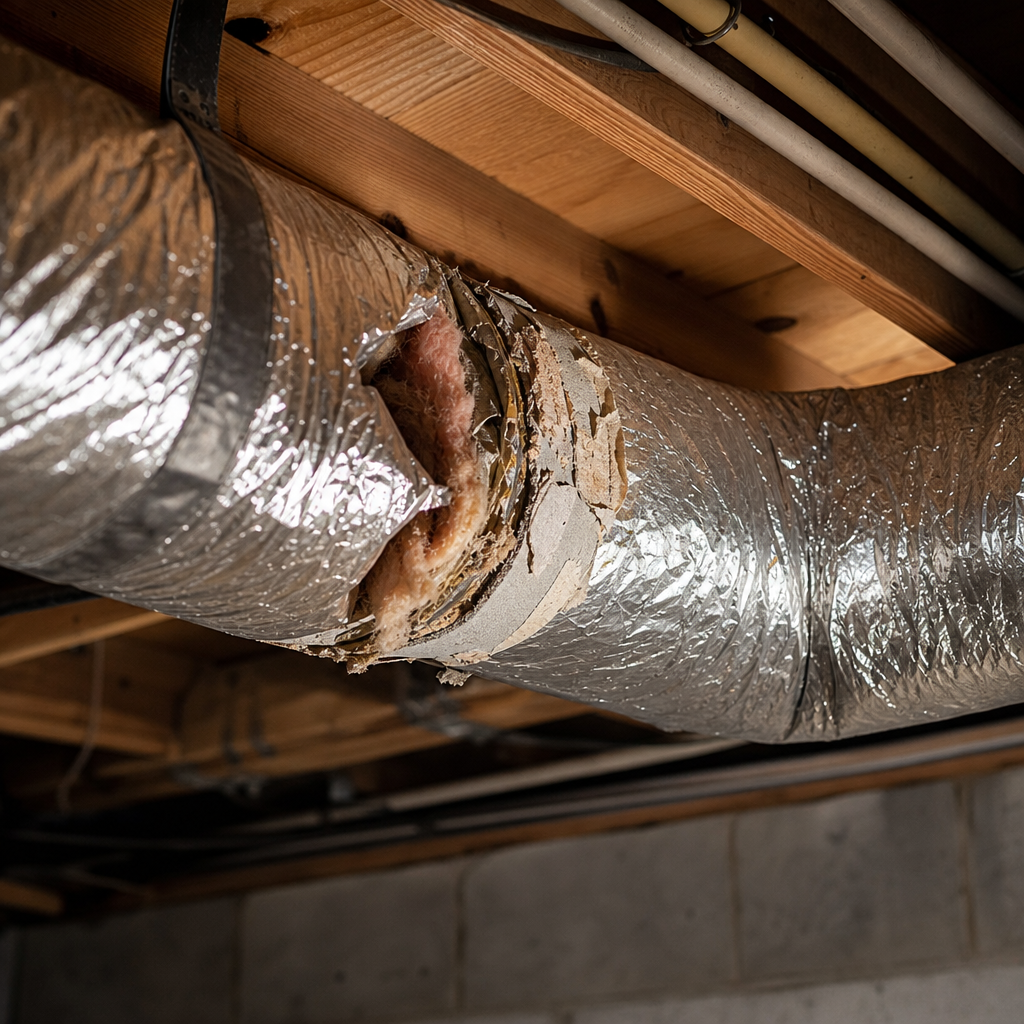
Duct issues rarely announce themselves with obvious noise. Instead, performance may drop quietly over time as connections separate and materials age.
1. Weak Airflow and Uneven Temperatures Between Rooms
Registers in distant rooms blowing weak or lukewarm air while rooms closest to the air handler stay comfortable can be a possible indicator of disconnected branch runs or tears along duct pathways, according to specialists at Northstar Air Duct Cleaning Service San Francisco.
2. Sudden Spikes in Heating and Cooling Bills
When supply ducts dump air into crawlspaces, heating and cooling equipment may run longer cycles to satisfy the thermostat. A HUD field test conducted outside Ashland reported an average 5% space-heating reduction and 65 fewer therms per home per year from duct sealing, though this represents a non-Ashland field study rather than a prediction specific to Ashland homes.
3. Dust Streaks and Musty Crawlspace Odors
Dark dust halos around registers or rooms that smell damp when the system operates can be possible indicators of unsealed seams or return-duct leaks drawing air from crawlspaces or attics.
Manual Mastic Sealing vs. Aeroseal: What Is the Difference?
Contractors typically use two main approaches for sealing residential ductwork, depending on accessibility and system condition:
- Manual Mastic and Foil Tape: Technicians physically access ducts to apply thick, water-based mastic paste embedded with fiberglass mesh tape over all joints, seams, and boot connections. Foil tape is used on flat metal connections. Standard cloth duct tape should not be used, as its adhesive degrades and peels over time. Manual sealing is ideal when ducts are readily accessible in open crawlspaces or attics, a method frequently utilized by Northstar Air Duct Cleaning Service San Francisco.
- Aeroseal (Aerosolized Duct Sealing): Technicians block supply and return registers, pressurize the duct system, and inject airborne sealant particles directly into the trunk lines. The polymer particles stick to the edges of hidden leaks and cracks. This method works well for sealing concealed duct runs hidden behind finished drywall or inside floor cavities.
The Static Pressure Trap: Why System Assessment Matters in Older Homes
Sealing duct leaks without evaluating overall system airflow can cause unintended operating issues in older regional homes. Heating and cooling systems rely on balanced airflow between supply air leaving the unit and return air entering it.
Caution is advised when modifying ductwork, as sealing supply runs without evaluating return capacity may alter system static pressure. A comprehensive system assessment and static-pressure checks before and after repairs may be appropriate professional practices to help verify proper system balance.
Frequently Asked Questions
How long does a professional duct repair and sealing job take?
Project durations depend on system condition, accessibility, and the sealing method employed. Timeframe estimates such as four to eight hours or a full day are unverified contractor estimates not established by the research brief.
Can duct sealing fix rooms that are always too hot or too cold?
Uneven room temperatures may be a possible indicator of duct leakage. Sealing duct runs can help improve airflow distribution across living spaces, though overall performance also depends on system sizing and design.
How do I know if my ducts need repair or a complete replacement?
Determining whether ductwork requires targeted repairs or section replacement depends on physical damage, accessibility, and overall system condition. Rather than assuming full replacement is more cost-effective than patching, homeowners should obtain an itemized professional assessment from experts like Northstar Air Duct Cleaning Service San Francisco to evaluate their options.
Who qualifies for the $250 Ashland duct-sealing incentive?
The City of Ashland, Oregon program offers a verified $250 prescriptive incentive for qualifying homes using electric heat sources. Homeowners should contact city conservation staff or review current utility guidelines to confirm specific property eligibility before beginning work.[3]
Need duct repair and sealing in Ashland?
We’re available now – call for a fast, free estimate.
Sources
- Climate & Energy Action Plan (CEAP) Report – ashlandoregon.gov (2050)
- [PDF] Remote Duct Sealing in Residential and Commercial Buildings – energy.gov
- Residential Incentives | Ashland, OR – ashlandoregon.gov
Duct Repair and Sealing in Nearby Cities
We also serve the communities around Ashland:
- Duct Repair and Sealing in San Francisco
- Duct Repair and Sealing in Alameda
- Duct Repair and Sealing in Alamo
- Duct Repair and Sealing in Albany
- Duct Repair and Sealing in Atherton
- Duct Repair and Sealing in Belmont
- Duct Repair and Sealing in Benicia
- Duct Repair and Sealing in Berkeley
Frequently Asked Questions
Why is static pressure testing essential during duct sealing?
Sealing supply leaks without evaluating return capacity can increase static pressure, which strains the blower motor and risks equipment failure. Northstar Air Duct Cleaning Service San Francisco performs pre- and post-repair airflow evaluations to ensure duct modifications maintain proper system balance.
Why is traditional cloth duct tape ineffective for long-term duct repairs?
Standard cloth tape uses rubber-based adhesive that degrades, cracks, and loses adhesion when exposed to seasonal temperature shifts in unconditioned crawlspaces and attics. Long-lasting repairs by Northstar Air Duct Cleaning Service San Francisco rely on mechanical sheet metal screws, fiberglass mesh, and durable commercial mastic paste.
How does a duct blaster test identify hidden leaks in home ductwork?
A duct blaster test temporarily pressurizes the duct network using a calibrated diagnostic fan to quantify total air leakage rates. Technicians at Northstar Air Duct Cleaning Service San Francisco use this diagnostic data to locate separated trunk lines and confirm airtight integrity across inaccessible branch runs.
About the author
 |
Sarah Miller Sarah is a certified HVAC technician with over 8 years of experience in residential air duct cleaning and maintenance. She specializes in improving indoor air quality for homeowners in the San Francisco Bay Area and holds an EPA Section 608 Certification. Her practical insights help families make informed decisions about their HVAC systems and dryer vents. |
Dusty vents or weak airflow at home?
We’re available now - call for a fast, free estimate.
Call Now - Free Estimate