
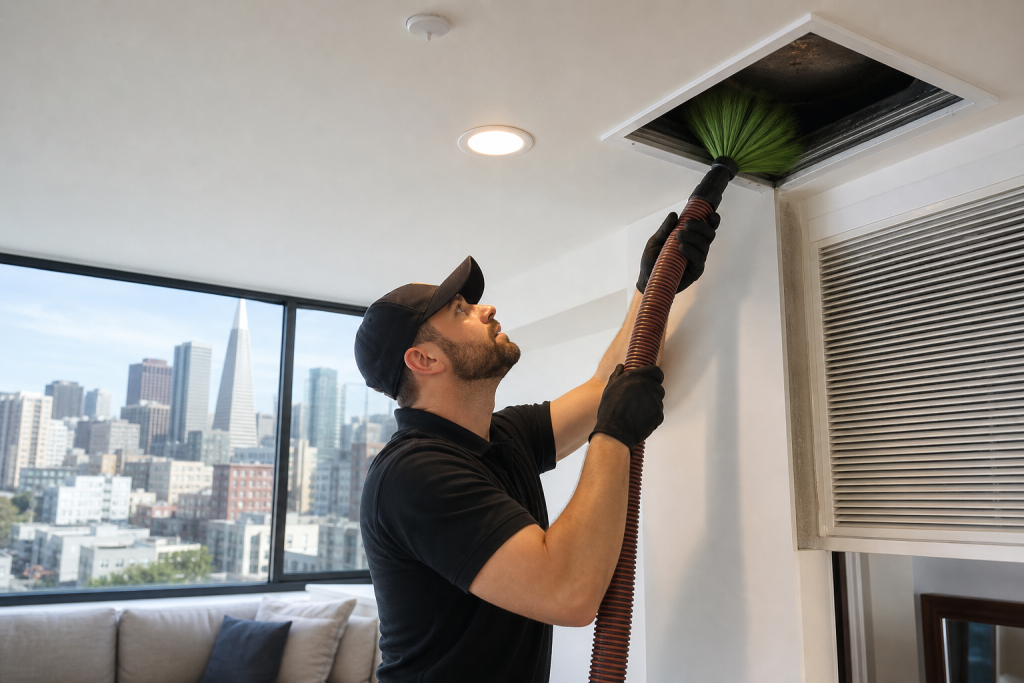
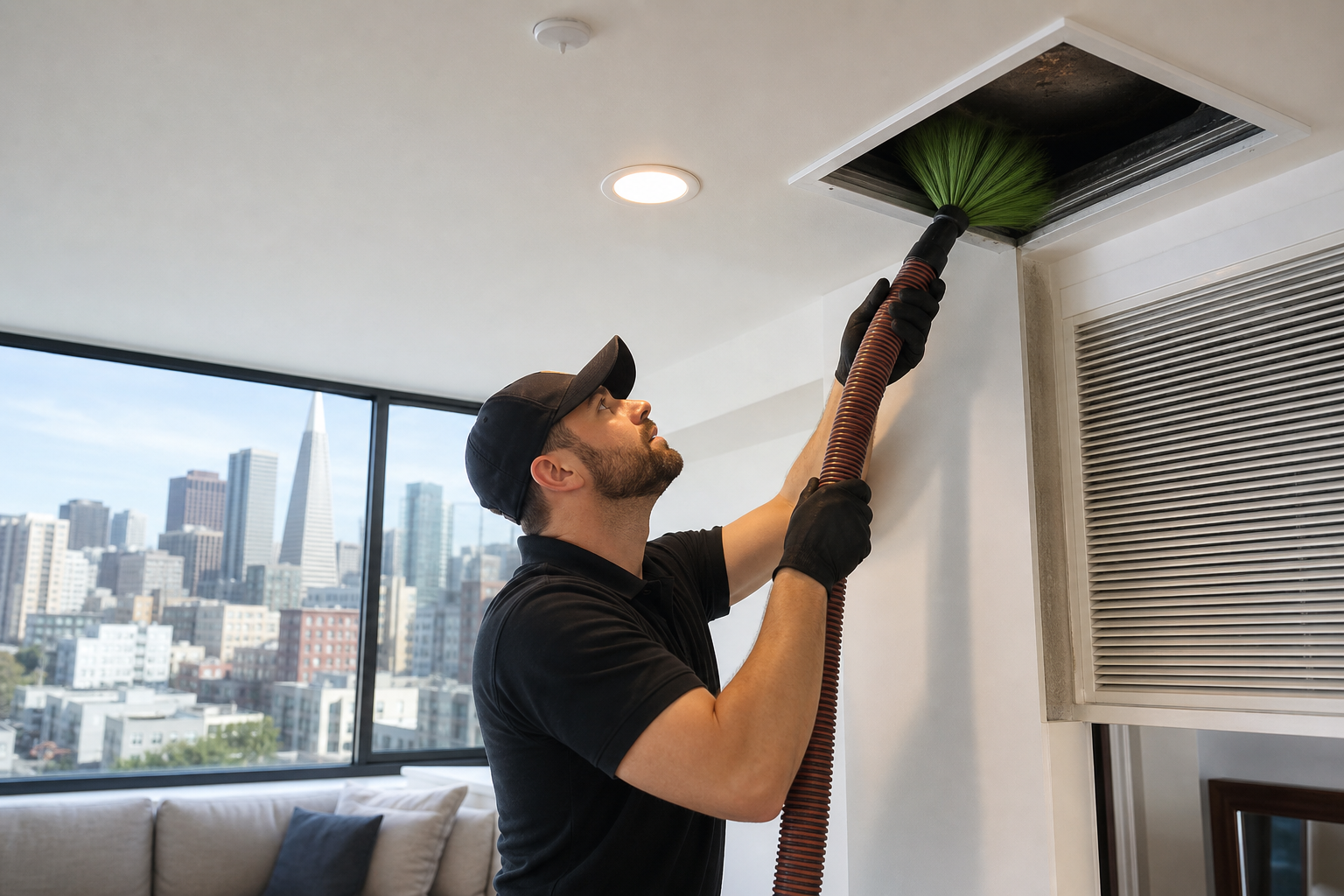
Emergency Air Duct Cleaning Near Me: What San Francisco Homeowners Should Do First
If you’re searching “emergency air duct cleaning near me” from a San Francisco home, the first step is to identify which type of emergency you’re facing — smoke intrusion, water damage, or contamination — because each requires a different immediate response before any contractor arrives. Shut down your HVAC system to stop circulation, open windows for ventilation if outdoor air quality permits, and avoid running your dryer until a professional assesses the ductwork. If the situation involves visible mold, strong chemical odors, or post-fire smoke residue, you’ll need same-day professional cleaning with commercial-grade equipment rather than a standard scheduled service — call Northstar Air Duct Cleaning Service San Francisco home at (855) 908-0725 and we’ll walk you through what to do in the next 30 minutes.
Here’s the mistake we see constantly: homeowners in the Sunset District or Bayview who’ve just had a kitchen fire or a water heater leak call us in a panic, then spend the first hour doing things that make the contamination worse. Running the “fan only” setting to “clear the air,” vacuuming visible soot near registers, or cranking up a portable air purifier without sealing the intake — these all redistribute particles deeper into the system. We’ve been at this 14 years, and the first 30 minutes of homeowner response genuinely changes what we find when we open the ducts with our Rotobrush inspection cameras.
The Three San Francisco Duct Emergencies — and the Different First Response Each Needs
Not every “emergency” is the same, and treating them identically wastes time and money. In our experience across San Francisco’s varied housing stock — from pre-war Victorians in Noe Valley to mid-century slabs in the Sunset — we see three distinct scenarios that trigger urgent searches.
Smoke Intrusion (Cooking Fires, Wildfire Drift, Neighbor Events)
San Francisco’s tight housing density means smoke travels between units more than people realize. When smoke enters your duct system, the particulate matter embeds in fiberglass lining and metal seams alike.
First response:
- Shut off HVAC immediately — do not run even fan-only mode
- Open windows on the opposite side of the home from the smoke source if outdoor air is clean
- Remove and discard the current filter; do not reinstall it
- Place damp towels over registers to limit settling (temporary, not a solution)
- Document with photos for insurance before touching anything
Smoke residue requires Nikro-powered agitation and HEPA extraction — household vacuums and standard duct cleaning won’t remove the oily particulate that wildfire smoke and protein fires leave behind. We treated a home in the Richmond last year where the homeowner had “cleaned” with a shop vac three times before calling us; the particulate had driven deep into flex duct runs that ultimately needed replacement.
Water Damage and Mold Risk (Flooding, Leaks, Condensation Events)
San Francisco’s marine climate already pushes humidity levels that encourage condensation in crawl spaces and attic runs. Add an active leak — water heater, roof penetration, or foundation seepage in low-lying areas like Bayview — and you’ve got 24–48 hours before mold establishes in duct insulation.
First response:
- Shut off HVAC to stop moisture circulation
- If safe, locate and stop the water source
- Remove standing water near registers with towels, not a vacuum (electrical hazard)
- Do not run dehumidifiers ducted through the system — this spreads spores
- Photograph water lines on ductwork for the technician
The critical distinction: water damage often requires duct repair and sealing before cleaning, or you’re sanitizing a system that will leak again. Our Abatement Technologies drying equipment can handle moisture in metal trunk lines, but fiberglass flex duct that’s been wet usually needs section replacement. We carry both capabilities because we’ve learned — over 1,209 jobs — that calling a cleaner who can’t repair creates a second appointment and more exposure time.
Contamination Events (Rodents, Sewage Backup, Chemical Spill)
Older San Francisco homes — particularly in neighborhoods like Bernal Heights and the Mission with mature trees and close rooflines — see regular rodent access to attics and crawl spaces. A single rat in a return duct creates a biohazard that standard cleaning won’t address.
First response:
- Shut off HVAC immediately
- Seal the room with the affected register if possible
- Do not attempt to remove debris yourself — hantavirus and leptospirosis are genuine risks
- Wash hands thoroughly if you’ve touched registers or nearby surfaces
- Note any access points you’ve observed (chewing sounds, droppings visible, odors)
This is where we deploy Honeywell and Aprilaire sanitizing protocols after mechanical cleaning — not as an upsell, but because organic contamination requires active treatment. We pulled a nest from a garage duct run in the Outer Sunset three weeks ago where the homeowner had “cleaned it out” with bleach spray; the moisture had driven contamination deeper, and the bleach had corroded a section of galvanized trunk line we then had to replace.
How to Tell “Same-Day Emergency” from “Urgent But Schedulable”
Not every concerning situation requires paying emergency rates or demanding midnight service. Here’s how we triage calls when San Francisco homeowners reach us at (855) 908-0725:
Same-day emergency indicators:
- Visible mold growth on registers or in duct openings
- Strong chemical or sewage odors when HVAC runs
- Post-fire smoke with active soot circulation
- Known rodent presence with HVAC currently operating
- Anyone in home with severe asthma, immunocompromise, or recent respiratory illness
Urgent-but-schedulable (typically 24–72 hours):
- Increased dust after renovation work
- Mild mustiness when system first kicks on
- Allergy symptoms that correlate with HVAC use but aren’t acute
- Dryer taking longer to dry (vent issue, not duct contamination)
- Preventive concern after neighbor’s water damage or fire
The difference matters for your wallet and our scheduling. We’ve had calls from Pacific Heights homeowners demanding midnight service for “dusty smells” that turned out to be a clogged dryer vent — something we handle efficiently by daylight with our Nikro equipment, not an emergency callout. Conversely, we’ve had Mission District renters wait three days on “mustiness” that was active black mold in a flooded crawl space return. When in doubt, describe what you’re seeing and smelling; we’ll tell you honestly whether you’re looking at same-day or next-available.
What to Tell the Contractor So They Bring the Right Equipment
The biggest delay in emergency response? The technician arrives with standard brushes and discovers they need HEPA containment, negative air, or repair materials. Here’s what changes what’s in our truck:
| Information you provide | What we bring differently |
|---|---|
| “Smoke from cooking fire, visible soot on ceiling register” | Nikro HEPA vacuum system, chemical-sponge pre-treatment, odor-sealing encapsulant |
| “Water heater leaked into crawl space, ducts are wet” | Abatement Technologies drying equipment, moisture meters, flex duct replacement stock |
| “Rat droppings in one register, heard scratching last week” | Full PPE, biohazard disposal, Honeywell/Guardsman sanitizing protocol, inspection camera with recording |
| “Renovation dust everywhere, system was running during work” | Rotobrush agitation with increased contact pressure, extended HEPA filtration run |
| “Baby has asthma, something triggered it suddenly” | Aprilaire air quality assessment tools, expedited sanitizing, post-clean verification sampling |
Photos help enormously. Text us images of registers, water lines, or visible debris before we load the truck. In 14 years, we’ve learned that five minutes of description saves an hour of return trips.
What a Legitimate Emergency Response Looks Like
San Francisco’s market has no shortage of companies promising “24/7 emergency service” who dispatch subcontractors with rental equipment and minimal training. Here’s what we think you should expect — and what we deliver:
The person who answers knows ducts, not just dispatch. When you call Northstar, Brian Rivera — owner and lead technician — handles your job personally. I’m the one who asks about register colors (soot? mold? rust?), who tells you whether to shut the breaker or just the thermostat, and who decides what equipment loads for your specific situation. No call center, no “we’ll have someone call you back.”
The equipment matches the problem. Generalist HVAC companies often show up with a basic rotary brush and a shop vac. For smoke, we bring Nikro-powered HEPA extraction. For moisture, Abatement Technologies drying and measurement. For contamination, Honeywell and Aprilaire treatment systems. The tool set should change based on what you described — if it doesn’t, you’re getting a standardized service, not an emergency response.
Documentation for insurance and landlords. True emergencies often involve claims. We photograph before, during, and after; we note moisture readings and particulate levels; we provide written scope of work. We’ve helped San Francisco homeowners document losses for everything from tenant disputes to wildfire relief claims.
Related services in San Francisco: If your emergency involves a dryer that’s overheating or a full HVAC system contaminated by the same event, we handle Dryer Vent Cleaning in Daly City and HVAC Cleaning in Daly City in the same visit — not parceled out to three different contractors. We also serve Air Duct Cleaning in Daly City with the same owner-led approach.
Key Takeaways: Your First 30 Minutes
- Shut it down: HVAC off, dryer off, any whole-house fan off — circulation is your enemy
- Ventilate selectively: Open windows only if outdoor air is cleaner than indoor (not during active wildfire smoke events)
- Remove the filter: Don’t let it become a reservoir; replace, don’t reinstall
- Document before touching: Photos for insurance, notes for the technician, timestamps for your own records
- Match the response to the threat: Smoke, water, and contamination each need different equipment — describe specifically when you call
- Verify who arrives: Owner-led, equipment-specific, documentation-capable — not just “someone tonight”
The Bottom Line
Emergency air duct cleaning in San Francisco isn’t about who answers the phone fastest — it’s about who arrives with the right equipment and the experience to assess whether cleaning alone solves your problem or whether you’re looking at repair, replacement, or ongoing treatment. We’ve spent 14 years focused exclusively on the air moving through Bay Area homes, and we’ve learned that the homeowners who fare best are the ones who take those first 30 minutes seriously: shut down circulation, ventilate smartly, document everything, and describe specifically what triggered the call.
If you’re in San Francisco and facing a duct emergency — or you’re not sure whether your situation qualifies — call Northstar at (855) 908-0725. Brian Rivera will answer, ask the questions that matter, and give you an honest assessment of whether you need us tonight or whether you’re better served by a scheduled visit with proper preparation. Estimates are free, and we’d rather point you toward the right timing than charge you for an emergency response you don’t need.
Frequently Asked Questions
Emergency same-day service in San Francisco typically runs $150–$400 above standard cleaning rates, with total costs ranging from $450–$1,200 depending on system size, contamination type, and whether repair or sanitizing is required. Standard scheduled cleaning for a typical single-family home starts around $350–$600. We don’t quote exact prices without seeing your system — call (855) 908-0725 for a free estimate based on your specific situation.
Yes, for genuine emergencies — active smoke circulation, visible mold with HVAC running, known rodent contamination, or water-saturated ductwork — we offer same-day response when you call before early afternoon. After 3pm, we may schedule first-thing-next-morning if the situation can be stabilized overnight (HVAC off, windows open, room sealed). We’ll tell you honestly whether your situation needs immediate response or next-available service — call (855) 908-0725 and we’ll triage together.
No. A new filter captures what passes through it, not what’s already embedded in duct lining, insulation, or mechanical components. After fire or flood, particulate and moisture have likely settled throughout the system; running the HVAC redistributes them into every room. Shut the system completely until a professional inspects with a camera. We’ve seen homeowners in the Marina and SOMA make this mistake and extend their cleaning scope significantly — call (855) 908-0725 before restarting.
Ask three specific questions: What equipment will you bring for my situation (they should name brands and types, not “professional tools”)? Who performs the work — owner, employee, or subcontractor? Can you provide documentation for insurance? At Northstar, Brian Rivera — owner and lead technician — handles your job personally with Rotobrush, Nikro, or Abatement Technologies equipment matched to your emergency, and we document everything. 1,200+ verified reviews. 4.9 stars. That’s not a marketing number — it’s a track record.
Written by Brian Rivera, Owner & Lead Technician at Northstar Air Duct Cleaning Service San Francisco, serving San Francisco since 2012.
Need Air Duct Cleaning Help?
Call Northstar Air Duct Cleaning Service San Francisco — licensed & insured, here with fast after-hours help in San Francisco.
(855) 908-0725